
Plant of the Month March 2026
GENERAL INFORMATION: This delightful, long-lived bulb may be sold as Fritillaria verticillata (as mine was) or F. verticillata var. thunbergii or F. thunbergii. According to fritillaria.org.uk/, F. verticillata flowers are bell shaped with square shoulders, while F. thunbergii has rounded shoulders. There is much confusion in the plant lists and the literature and also uncertainty of its exact origin. It is used in Asian medicine.
Common Name: Whorled Fritillary.
Life Cycle: Perennial clump-forming bulb. Each bulb with 2 scales, about 2 cm in diameter.
Height: to 30 cm or more.
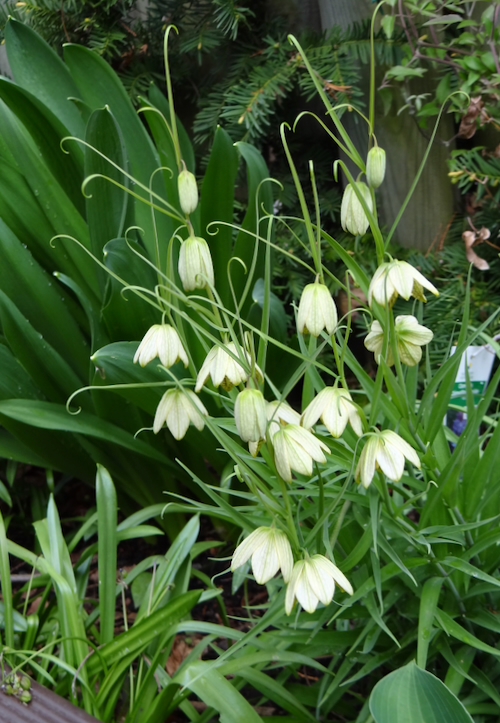
Fritillaria thunbergii.
Bloom Time: End of April to early May in Southern Ontario.
Flower Colour & Size: Can have racemes of up to 15 down-facing bell-shaped, pale greenish flowers, about 2.5 - 4 cm long, with brownish chequered pattern inside. F. thunbergii has a rounded shape.
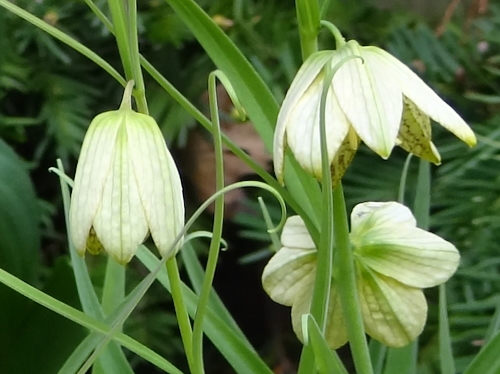
Fritillaria thunbergii - flowerrs.
Scent: Unscented.
Leaves: Lanceolate to linear narrow, grey green, up to 9 cm long in whorls of 5 or more. They twist and end in a curled tendrils.
Fruit: A 3 chambered, 6 angled capsule with many flat seeds. My plant has never produced seeds.
Range: Fritillaria thunbergii is native from western China to Japan. F. verticillata is native from South Siberia to Japan.
Habitat: Hills, thickets, gravelly meadows.
CULTIVATION:
Plant: Deeply.
Light: Partial to full sun.
Soil: Most well drained soils.
Water: Average. Avoid wet winter conditions.
USDA Hardiness: Zones 4-9.
Pests and Diseases: Possibility of lily beetle or slugs. Usually disease free.
Companion planting: Rock garden plants, low spring bulbs, small Hosta.
Pollinators: Bees, flies.
Propagation: Divide bulbs when dormant in fall.
Seedex availability: Best with fresh seed. Try planting outdoors with winter temperatures including freezing for 3 months. Grow seedlings in cool temperature and leave in pot for 2 years.
Toxicity: Used in Chinese medicine
References:
https://www.rhs.org.uk/plants/7444/fritillaria-verticillata/details
https://www.fritillaria.org.uk/fritillaria-species-t---z.html
http://www.efloras.org/florataxon.aspx?flora_id=2&taxon_id=200027649
https://www.inaturalist.org/taxa/452303-Fritillaria-verticillata
https://en.wikipedia.org/wiki/Fritillaria
https://www.phoenixperennials.com/plant-encyclopedia/
https://www.rhs.org.uk/plants/
https://www.missouribotanicalgarden.org › PlantFinder
https://pacifichorticulture.org/articles
Text and images supplied by Anna Leggatt